
Views: 90 Author: Site Editor Publish Time: 2026-02-13 Origin: Site
When you are responsible for safety at sea, choosing the right rescue boat or lifeboat is not just a technical decision—it is a commitment to protecting every person on board. Fiberglass rescue boats and fiberglass lifeboats are now the standard choice on many commercial ships and offshore installations because they combine strong performance with long service life in harsh environments.
This guide explains when fiberglass is the right option and how to select the best fiberglass rescue boat or fiberglass lifeboat for your vessel.
What Is a Fiberglass Rescue Boat or Lifeboat?
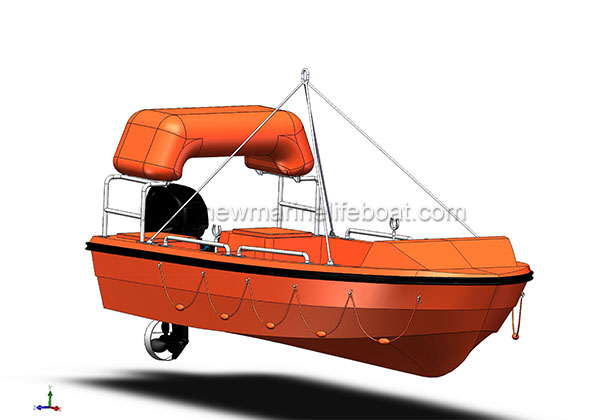
A fiberglass rescue boat is a small, maneuverable craft built with an FRP (fiberglass reinforced plastic, also commonly referred to as GRP) hull, used for man-overboard recovery, towing, and near-field search and rescue operations. It is usually launched by davit, designed to get to the casualty quickly, and stable enough to recover people safely in rough water.
A fiberglass lifeboat is a survival craft designed to evacuate crew and passengers from the mother vessel and keep them safe until help arrives. Many modern lifeboats are totally enclosed or free-fall types, built from fiberglass to protect occupants from fire, waves, wind, and extreme temperatures while carrying food, water, and emergency equipment.
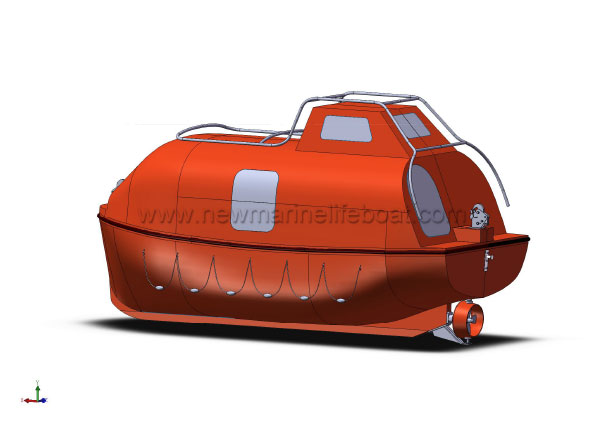
In both cases, fiberglass is used for the hull and often the superstructure, providing a rigid, corrosion-resistant shell.
When Fiberglass Is the Right Choice
Fiberglass has become the default material for many rescue boats and lifeboats, but it is still important to check that it matches your operating profile.
Recommended Operating Conditions
You operate in saltwater or mixed environments and need strong resistance to corrosion and fouling over many years.
Your launch and recovery systems benefit from lower boat weight, for example small davits or limited deck space.
You want predictable maintenance with minimal structural rust repairs and a clean gel-coat surface that is easy to inspect.
Key Advantages
High strength-to-weight ratio: Fiberglass hulls can be engineered to withstand impact and heavy sea states while staying lighter than equivalent steel structures.
Corrosion resistance: FRP does not rust in saltwater and stands up well to UV exposure with proper coatings.
Design flexibility: Complex hull shapes, seating layouts, and enclosed cabins are easier to mold in fiberglass, which is useful for both fast rescue boats and enclosed lifeboats.
Potential Trade-Offs
Repair technique: Structural repairs require composite skills and correct resin systems, which may not be available in every port.
Impact sensitivity: While fiberglass is tough overall, severe point impacts can cause localized cracking or delamination, so inspection routines must be followed.
For most commercial ships and offshore units, these trade-offs are acceptable, and fiberglass becomes the most practical option across the full life of the equipment.
How to Choose the Right Fiberglass Rescue Boat

When selecting a fiberglass rescue boat, you are balancing speed, capacity, and compatibility with your vessel. Key points to evaluate include:
Mission and Operating Area
Fast man-overboard response in open sea requires good speed, deep-V or semi-V hulls, and reliable handling in waves. Harbor, river, or sheltered-water operations may allow slightly smaller or lower-powered fiberglass rescue boats.
Capacity and Dimensions
Confirm that the length, beam, and depth fit your davit and deck layout while meeting the required number of persons and equipment load. SOLAS rescue boats are typically required to achieve a minimum speed of 6 knots when fully loaded and be maneuverable for recovery operations.
Propulsion and Speed
Outboard gasoline engines are common on smaller fiberglass rescue boats and are straightforward to maintain worldwide. For fast rescue craft, engine power and hull design must deliver the minimum speeds specified by flag and class rules.
Launching and Recovery
Check that the boat is compatible with your existing single-arm davits, A-frame davits, or daughter-craft crane arrangements. Look for documented hook positions, lifting points, and weight data so your launching system can be engineered or verified correctly.
Safety and Equipment Fit-Out
Non-slip decks, grab lines, self-bailing features, and compliant navigation lights are important details for real-world rescue work. Make sure the standard equipment list, including communication and recovery gear, meets SOLAS requirements and your internal procedures.
How to Choose the Right Fiberglass Lifeboat

Choosing a fiberglass lifeboat involves broader considerations because it is the last line of defense in a worst-case scenario. Decisions usually start with:
Lifeboat Type
Open or partially enclosed fiberglass lifeboats may still be suitable for some vessels, but many operators now favor totally enclosed lifeboats to shield occupants from wind, spray, and fire. Free-fall fiberglass lifeboats provide rapid launch clear of the ship's side and are common on tankers and some offshore units where quick separation is critical.
Capacity and Vessel Layout
You need enough seats for everyone on board, often split between multiple lifeboats, with seating arranged according to the vessel's muster plan and embarkation stations. Totally enclosed fiberglass lifeboats often range from around 5 m to over 7.5 m, with capacities from 16 to 60 persons depending on model.
Compliance and Approvals
Lifeboats must be designed and tested to SOLAS, the LSA Code, and relevant IMO resolutions, and typically carry class approval from societies such as CCS, BV, or equivalent organizations. Check that certificates match your flag state and vessel type, and that documentation covers both hull materials (FRP) and safety systems.
Integration with Launching Equipment
Hook distance, full-load weight, and interface with on-board davits or free-fall ramps must all be verified. Installation guidelines, commissioning services, and maintenance support from the manufacturer help ensure safe lifetime operation.
Environmental and Route Conditions
For cold regions, enclosed fiberglass lifeboats with appropriate insulation and heating may be necessary, while fire-protected models are usually favored on tankers and hazardous-cargo ships.
Example Configurations and Typical Specifications
The following simplified examples show how fiberglass rescue boats and lifeboats might be specified in practice.
Coastal Cargo Vessel
One fiberglass rescue boat sized for man-overboard recovery, FRP hull and deck, outboard propulsion, and performance suitable for SOLAS rescue operations.
Two totally enclosed fiberglass lifeboats sized to cover the full complement, each with diesel inboard propulsion, fire-protected construction, and hook distances matched to davit positions.
Offshore Platform
One or more free-fall fiberglass lifeboats, fire-protected, with capacities aligned to the maximum number of persons on board and launch skids designed to clear platform structures.
A fast fiberglass rescue boat with higher installed power, reinforced hull construction, and good sea-keeping for stand-by, man-overboard recovery, and close-range support.
Passenger Vessel/Ferry
One or more fiberglass rescue boats arranged for frequent man-overboard response, davit-launched, with seating and deck layouts suited to rapid recovery operations.
Totally enclosed fiberglass lifeboats arranged to cover passenger and crew capacity, with seating and embarkation layouts aligned with the vessel's evacuation routes.
Work with New Marine for Reliable Fiberglass Lifeboat & Rescue Boat Solutions

New Marine designs and manufactures fiberglass rescue boats and fiberglass lifeboats with a focus on regulatory compliance, operational reliability, and practical shipboard integration rather than over-specification. Key strengths include:
Dedicated FRP construction: Hulls and decks are built in fiberglass reinforced plastic using proven lay-up processes, with buoyancy arrangements designed to support impact resistance and stability.
Broad product coverage: Offerings include standard rescue boats, fast rescue craft, totally enclosed lifeboats, and free-fall lifeboats suitable for a wide range of vessel types.
Clear technical documentation: Detailed specifications on dimensions, capacity, weight, speed, and engine configuration support accurate davit matching and safety planning.
Regulatory alignment: Designs are developed in accordance with SOLAS, the LSA Code, and applicable classification society requirements.
Project-oriented support: Assistance is available from selection and specification through installation and commissioning.
If you are planning a newbuild or upgrading existing lifesaving appliances, contact New Marine for a free consultation—our technical teams can review your vessel type, route, and flag-state requirements and identify fiberglass lifeboats and rescue boats that align with your safety plan and operational conditions.


