Views: 61 Author: Site Editor Publish Time: 2026-09-16 Origin: Site
Choosing between an inboard and outboard rescue boat is a system decision, not simply an engine preference. The propulsion package affects boat weight, deck arrangement, servicing access, fuel type, launch-and-recovery planning, and how the craft fits the vessel’s operating profile. A useful comparison therefore starts with the mission, then checks the boat, engine, propulsion, and davit as one integrated package.
An outboard configuration is often attractive when the project values a lighter installation, straightforward engine access, and a familiar gasoline outboard package. An inboard configuration is often considered when the vessel needs an integrated engine installation and water-jet propulsion, or when its technical and fuel arrangements are better aligned with an inboard package. The final choice should be confirmed against approved performance, loaded condition, recovery arrangement, service support, and the rules applicable to the vessel.
The terms describe where the engine is installed, but the practical distinction extends beyond location. An outboard engine is mounted at the stern as a self-contained engine and propulsion unit. An inboard engine sits within the boat and transfers power through a separate propulsion system. In New Marine’s fast rescue boat range, the listed inboard arrangement uses water-jet propulsion, while the outboard NM60R is presented with a gasoline outboard engine.
Because the propulsion architectures differ, a like-for-like review should consider the complete rescue craft rather than compare horsepower alone. Hull geometry, displacement, loading, engine rating, propulsion losses, fuel, and sea conditions all influence actual performance. Published speed should be read together with the test loading and selected engine package.
Decision factor | Outboard configuration | Inboard configuration |
|---|---|---|
Package arrangement | Engine and drive unit mounted at the stern | Engine installed within the craft with a separate propulsion system |
Weight and recovery | Can support a lighter overall package; verify loaded recovery weight | Typically a heavier package; confirm davit and hook compatibility |
Service access | External engine access can simplify removal or replacement planning | Requires planned access to the internal engine and associated systems |
Propulsion fit | Conventional outboard package suited to projects standardized around that engine type | Can pair with water jet where an integrated inboard solution is preferred |
Procurement focus | Engine availability, gasoline handling, transom arrangement, service network | Engine/jet match, internal layout, ventilation, fuel integration, service access |
Start with what the craft must do after launch. Define typical crew, survivor capacity, expected range, response time, sea state, patrol or standby duty, and whether the boat will frequently maneuver near people, lines, debris, or floating equipment. These inputs shape the suitable engine rating and propulsion package more reliably than a general preference for one engine location.
Weight is especially important for a ship-launched rescue craft because the boat, persons, equipment, fuel, hook, and recovery arrangement interact. New Marine lists an unloaded weight of 1,175 kg for the NM60R outboard version and 1,734 kg for the listed inboard versions. That difference makes configuration selection directly relevant to davit sizing, structural interfaces, safe working load, and recovery planning. Procurement teams should compare the complete operational load, rather than using unloaded boat weight as the sole interface value.
The outboard package provides a conventional stern-mounted solution. The listed New Marine inboard package uses a shaft-drive-to-water-jet arrangement. A water jet encloses the working elements within the propulsion unit rather than placing an exposed propeller behind the craft, which can be useful when propulsion architecture and close-quarters operating requirements point in that direction. Selection still depends on the complete installation, intake conditions, operator training, and the approved performance of the exact boat-engine combination.
Fuel strategy can quickly narrow the choice. New Marine identifies the outboard type as gasoline and lists several inboard engine options. The mother vessel’s fuel policy, storage arrangement, refueling procedure, ventilation, fire-safety design, and maintenance capability should all be included in the specification review. A propulsion option that aligns with onboard technical practice can simplify routine readiness and logistics over the craft’s service life.
Outboards provide direct external access and can support practical removal or engine replacement planning. Inboard systems place the engine and supporting components within the craft, so access space, inspection points, ventilation, jet servicing, and spare-parts planning deserve attention during layout review. For either option, local engine support, technician familiarity, diagnostic capability, preservation routines, and parts lead times can matter as much as the initial equipment price.
Avoid treating “inboard” or “outboard” as a speed category. New Marine’s published NM60R range illustrates why: both propulsion types are available in a six-meter platform, while listed inboard engine packages include different speed levels. The product page lists an outboard model at at least 20 knots with three persons, an inboard group at at least 20 knots with three persons, and a higher-powered inboard group at at least 33 knots with three persons. The meaningful comparison is therefore the exact configuration, engine, payload, and approval basis.
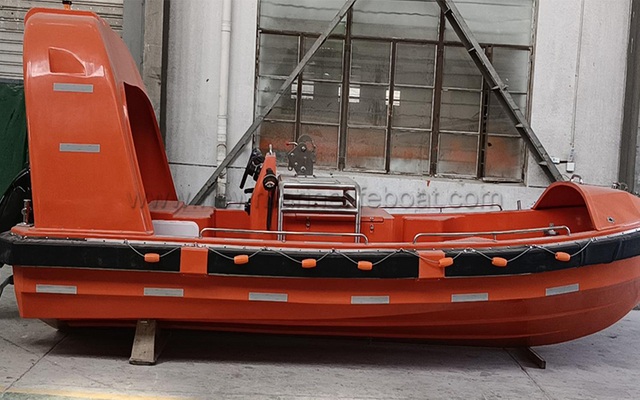
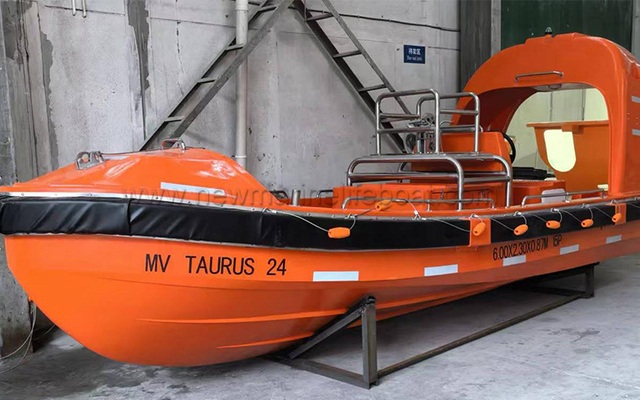
New Marine’s fast rescue boat range gives buyers a direct product-level comparison. The NM60R outboard and inboard versions share published dimensions of 6.00 × 2.30 × 0.87 m and a listed capacity range of 3–15 persons at 82.5 kg per person. The range page describes an FRP hull and deck, stainless-steel fittings, self-righting capability, and matching davit options. Buyers can review the complete fast rescue boat range before selecting the propulsion package.
The published outboard model uses a Mercury 60 HP engine. Its listed unloaded weight is 1,175 kg, with a speed of at least 20 knots at the stated three-person condition. This option creates a clear specification path for projects that favor an outboard package and value the lower listed unloaded weight. The RFQ should identify the required payload, fuel arrangement, engine service region, and final davit interface.
The inboard NM60R is listed with several engine choices, including packages from BUKH, Steyr, Yanmar, and SY. Published variants include at least 20-knot and at least 33-knot three-person speed levels, with an unloaded weight of 1,734 kg. This creates room to match the inboard configuration to the project’s performance target and technical preferences while keeping the same listed principal boat dimensions and capacity range.
A focused RFQ allows the manufacturer to compare suitable configurations without relying on a generic inboard-versus-outboard assumption. Include the following information:
vessel type, flag, class, build or retrofit status, and delivery schedule;
required rescue-boat or fast-rescue-boat duty and applicable approval basis;
crew, survivor capacity, equipment load, and operating radius;
target speed and the payload condition attached to that target;
preferred fuel, engine brand requirements, and local service location;
launching height, available deck envelope, hook arrangement, and davit details;
expected operating water, temperature range, sea conditions, and debris exposure;
required spares, documentation, commissioning, and crew training support.
These details allow the boat, propulsion, hook, and launching appliance to be reviewed together. They also make quotations easier to compare because each supplier is responding to the same mission and interface conditions.
The best inboard vs outboard rescue boat decision is the one that fits the vessel’s mission, technical arrangements, launch-and-recovery system, and support network. Outboard propulsion can offer a lighter, accessible package; an inboard water-jet configuration can provide a more integrated propulsion path with multiple engine and performance choices. Neither label replaces configuration-level verification.
For a project-specific comparison, share your operating profile and davit information with New Marine. The team can help align the NM60R propulsion package, performance target, and launching arrangement for your vessel.